Biogas plants have become an integral part of the modern energy landscape. They convert organic waste into usable energy and make a significant contribution to the energy transition. But how exactly does a biogas plant work? What components are required? This article explains how a biogas plant works in a comprehensive and practical way – from the initial substrate right through to the generation of electricity and heat.
How does a biogas plant work – the basic principle
A biogas plant utilises a natural biological process: anaerobic digestion. In this process, microorganisms break down organic materials in the absence of oxygen. The result is biogas, which consists mainly of methane (CH₄) and carbon dioxide (CO₂). This biogas is then used to generate energy – usually in a combined heat and power (CHP) plant, which produces both electricity and heat simultaneously.
The basic principle is therefore very simple: organic material goes in, biogas comes out, energy is used. However, behind this simple formula lies a complex interplay of biology, process engineering and plant engineering, which only works when all elements interact optimally.
The key components of a biogas plant
To understand how a biogas plant works, it is important to be familiar with the individual components and their functions. A typical biogas plant consists of the following main components:
Pre-digester or substrate reception
This is where the process begins. All organic feedstocks – also known as substrates – are collected and prepared in the pre-digester. These include slurry, manure, maize silage, grass, biowaste and organic residues from the food industry. The substrates are often shredded, mixed and adjusted to the correct consistency here to ensure they can ferment optimally later on.
Fermenter (main digester)
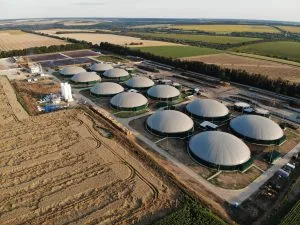
The fermenter is the heart of every biogas plant. The actual fermentation takes place in this airtight container. Here, millions of microorganisms work under oxygen-free (anaerobic) conditions to break down the organic matter. This process produces valuable biogas.
The fermenter is heated to a constant temperature of around 35 – 42 °C (mesophilic) or 50 – 55 °C (thermophilic), as the bacteria only function optimally within this temperature range. Agitators ensure uniform mixing so that no floating or settling layers form and all areas ferment evenly.
Secondary digester
After passing through the fermenter, the partially fermented substrate is often fed into a secondary fermenter. Here, fermentation continues under similar conditions, albeit at a lower intensity. The secondary fermenter increases the gas yield and ensures a more stable quality of the digestate.
Gas storage
The biogas produced must be temporarily stored, as production and consumption do not always occur simultaneously. The gas storage tank is often fitted as a flexible cover directly onto the fermenter or secondary fermenter. This foil cover rises and falls depending on the volume of gas.
Combined heat and power (CHP) plant
In the CHP plant, the biogas is combusted and converted into mechanical energy in a gas engine or gas turbine, which drives a generator. This generates electricity. At the same time, waste heat is generated, which can be used to heat the digester, residential buildings or greenhouses. This principle of combined heat and power makes biogas plants particularly efficient.
Digestate storage
What remains after fermentation is the digestate. It still contains all the nutrients such as nitrogen, phosphorus and potassium and can be used as a high-quality fertiliser for agriculture. The digestate storage facility holds these residues until they can be spread on the fields.
How a biogas plant works, explained simply – step by step
To aid understanding, the operation of a biogas plant can be broken down into the following steps:
Step 1: Substrate reception and preparation
The organic feedstocks are delivered, collected in the pre-pit and, if necessary, shredded or mixed. A uniform substrate composition is important for a stable digestion process.
Step 2: Feeding the digester
The prepared substrate is fed into the fermenter either continuously or at regular intervals. Modern plants use automated feeding technologyfor this, which enables precise dosing.
Step 3: Anaerobic digestion
The actual biogas production begins in the fermenter. Various bacterial strains work together in several phases (hydrolysis, acidogenesis, acetogenesis, methanogenesis) to gradually break down the complex organic molecules. The end product is biogas with a methane content of around 50 – 70 per cent.
Step 4: Gas storage
The biogas produced rises to the top and is collected in the gas storage tank. From here, it can be drawn off as required.
Step 5: Energy generation
The biogas is fed into the combined heat and power (CHP) plant, where it is combusted. The generator produces electricity, which is fed into the grid or used on-site. The waste heat heats the digester and can be used for other purposes.
Step 6: Digestate utilisation
The fermented material is discharged as digestate, collected in the digestate storage facility and later applied as fertiliser in agriculture. This closes the cycle.
How does a biogas plant work biologically – the fermentation process in detail
The biological function of a biogas plant is based on a multi-stage microbial decomposition process. Each phase is carried out by specialised groups of bacteria:
Phase 1: Hydrolysis
In the first phase, hydrolytic bacteria break down complex organic polymers such as carbohydrates, proteins and fats into smaller building blocks: sugars, amino acids and fatty acids. This step is particularly important for structurally complex substrates such as straw or maize silage.
Phase 2: Acidogenesis (acidification)
The resulting monomers are further broken down by acidogenic bacteria. This produces short-chain fatty acids (such as acetic acid, propionic acid and butyric acid), alcohols, hydrogen and carbon dioxide. This phase proceeds relatively quickly and, if the feed mixture is unbalanced, can lead to over-acidification of the fermenter.
Phase 3: Acetogenesis
Acetogenic bacteria convert the acids and alcohols into acetic acid, hydrogen and CO₂. These substances are the direct precursors for methane formation. Acetogenesis is a sensitive process that only proceeds efficiently at low hydrogen concentrations.
Phase 4: Methanogenesis
In the final phase, methanogenic archaea (not bacteria!) produce the methane itself. They utilise either acetic acid (acetoclastic methanogenesis) or hydrogen and CO₂ (hydrogenotrophic methanogenesis). These microorganisms are highly specialised, grow slowly and are sensitive to temperature fluctuations, changes in pH or toxins.
Only when all four phases are in equilibrium does the biogas plant produce high-quality biogas continuously and consistently.
How a biogas plant works: What factors influence its performance?
The efficiency and gas yield of a biogas plant depend on several factors:
Substrate quality and composition
Not every substrate yields the same amount of gas. High-energy substrates such as maize silage or fats have a high methane potential, whilst structurally rich materials such as straw are more difficult to break down. A balanced mixture – known as the substrate mix – is crucial for stable biological processes.
Temperature
The process temperature directly influences the activity of the microorganisms. Mesophilic plants (35 – 42 °C) are widely used and robust. Thermophilic plants (50 – 55 °C) achieve higher degradation rates and sanitise the substrate more effectively, but require more thermal energy and are more prone to malfunctions.
Retention time
The retention time indicates how long the substrate remains in the fermenter. Typical values range between 30 and 100 days. The longer the retention time, the more complete the fermentation – but the larger the fermenter must also be.
Agitation technology
Good mixing prevents the formation of floating and sinking layers, ensures even temperature distribution and improves contact between the bacteria and the substrate. Modern paddle agitators such as the Varibull operate in an energy-efficient and gentle manner.
pH value and trace elements
The optimum pH value for methane production is between 6.5 and 8.0. In addition, the microorganisms require trace elements such as iron, nickel, cobalt or selenium. A deficiency can significantly reduce gas production.
Biogas plants in practice: different plant types
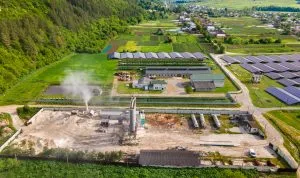
Depending on the intended use, substrate and location, different types of plant are employed:
Agricultural biogas plants
These plants are usually operated by farmers and primarily process slurry, manure and renewable raw materials such as maize or grass. They generate electricity and heat for their own use or feed it into the grid. The digestate is spread as fertiliser on the farmers’ own land.
Industrial biogas plants
These plants process organic waste from the food industry, slaughterhouse waste or bio-waste from household organic waste bins. These plants are often larger and technically more complex, as they have to handle a variety of substrates, some of which are problematic.
Biogas purification plants
In biogas upgrading, the raw biogas is purified and brought up to natural gas quality (biomethane). To achieve this, the CO₂ is separated and the methane content is increased to over 95 per cent. The biomethane can be fed into the natural gas grid or used as a fuel.
Small-scale biogas plants
For smaller agricultural holdings or decentralised supply schemes, there are compact biogas plants with lower capacity. They are simpler to operate and remain economically viable even with smaller quantities of substrate.
Advantages and disadvantages of biogas plants – how they work
Like any technology, biogas technology has its strengths and limitations:
Advantages:
- Renewable energy: Biogas is climate-friendly and can be stored
- Circular economy: Waste materials are put to good use
- Fertiliser: Digestate is a high-quality organic fertiliser
- Flexibility: Biogas can be accessed as and when required
- Regional economic benefit: Energy is generated locally
Challenges:
- High investment costs: Building a plant is expensive
- Technical complexity: Biology and technology must work together seamlessly
- Land requirements: The cultivation of energy crops competes with food production
- Odour emissions: Odours may occur if the plant is not operated correctly
- Maintenance requirements: Regular inspection and maintenance are necessary
Technical innovations: How modern plants operate more efficiently
Biogas technology is constantly evolving. Modern components and processes improve efficiency and cost-effectiveness:
Feeding technology
Automated solid dosing ensures precise substrate quantities and reduces the workload. Systems such as the Easyfeeder series enable uniform, energy-efficient feeding.
Agitators
Energy-efficient paddle agitators such as the Varibull require significantly less electricity than conventional submersible motor agitators, whilst still ensuring optimum mixing.
Separation technology
Screw press separators separate the digested residue into a solid and a liquid phase. The liquid phase can be specifically applied as a nitrogen fertiliser, whilst the solids are used as bedding or for composting.
Heat exchangers
Substrate heat exchangers utilise the waste heat from the CHP unit to preheat cold substrates. This saves heating energy and increases the overall efficiency of the plant.
Digestate evaporation
Digestate evaporation systems such as the Vapogant remove excess water from the digestate. This reduces storage volume by up to 70 per cent and makes transport more cost-effective.
Optimising the biogas plant: tips for higher gas yield
Operators can improve their plant’s performance through targeted measures:
- Substrate management: A balanced mix of different substrates with high gas yield potential
- Trace elements: Regular monitoring and addition as required
- Agitation strategy: Adjusted agitation times and intensity depending on the substrate
- Temperature stability: Avoiding fluctuations through optimised heating
- Pre-treatment: Mechanical or thermal processing of substrates that are difficult to degrade
- Sanitisation: Reliable elimination of pathogens in animal-derived materials
- Process monitoring: Regular analysis of pH, gas quality and organic acids
Safety and environmental protection in biogas plants
The safe operation of a biogas plant requires particular attention:
- Gas tightness: All pipes and tanks must be completely leak-proof
- Explosion protection: Biogas is flammable, so strict explosion protection requirements apply
- Emergency shutdown: Automatic safety systems in the event of malfunctions
- Emissions control: Closed systems prevent methane emissions
- Monitoring: Continuous monitoring of pressure, temperature and gas levels
Modern plants meet high environmental standards and actively contribute to climate protection, as they replace fossil fuels and prevent methane emissions from the open storage of slurry.
Cost-effectiveness: Is a biogas plant worth it?
Profitability depends on many factors:
- Feed-in tariff: Government support under the Renewable Energy Sources Act (EEG)
- Substrate costs: On-site residues are cheaper than purchased energy crops
- Heat utilisation: The more waste heat that is utilised, the better the overall balance
- Plant size: Larger plants are often more cost-effective
- Operating costs: maintenance, repairs, insurance and staffing
Despite high initial investment, biogas plants can be economically viable over their 20 – 25-year lifespan – particularly when integrated into a well-thought-out overall strategy.
Conclusion: Understanding and utilising the biogas plant’s function
A biogas plant is far more than just a technical system – it is a living organism in which biology and technology work hand in hand. Understanding how a biogas plant functions is the basis for efficient, safe and economical operation.
From substrate intake through anaerobic digestion to energy generation – every step in the process must be optimally designed. Modern components such as efficient agitators, intelligent feeding technology and innovative digestate treatment help to get the most out of every plant.
Biogas plants make a significant contribution to the energy transition: they generate baseload electricity, utilise local resources, close nutrient cycles and reduce greenhouse gas emissions. With the right expertise and the appropriate technology, operators can continuously optimise their plants and thus operate successfully both economically and environmentally.