Wavebox Ultraschalltechnik für BIogasanlagen
Ultraschalltechnik für Biogas- und Kläranlagen
Ultrasonic technology makes it possible to break down unfermented and previously undegraded fibres. This results in an even higher gas yield!
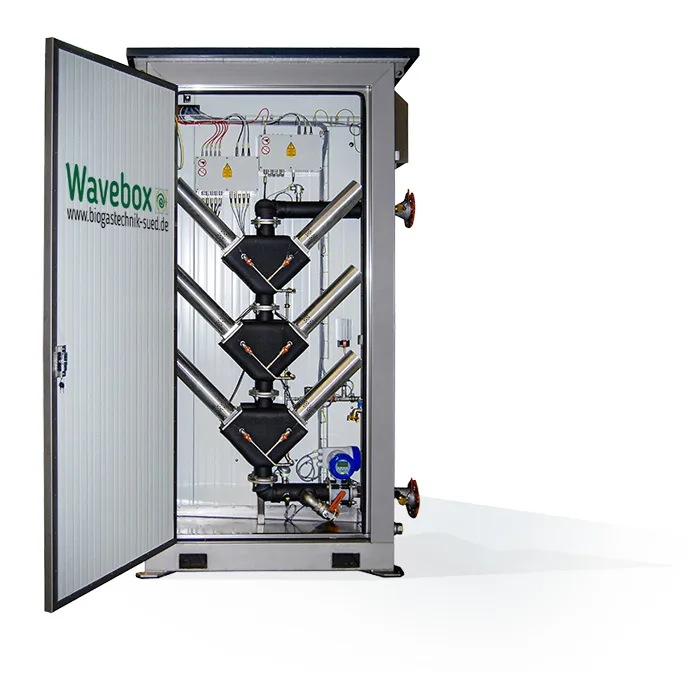
Wavebox in a container
The problem & the solution
Between 8% and 15% of the digestate produced consists of fibres that have not yet been fermented or broken down. Despite conventional techniques, it is not possible to completely break down these fibres.
By skilfully integrating ultrasonic technology into the existing biogas plant system, it is possible to break down the fibres even more effectively and quickly, and to release the organic matter. Breaking down the fibres results in a faster rate of decomposition. This allows greater output to be achieved from the same tank system.
Steigerung ihres Biogasertrags von bis zu 20 % möglich.*
- Prevention of emissions from separation systems
- Increasing the gas-forming potential of thefeedstocks
- Reduction of the residual gas potential in the digestate
- Standard anaerobic digestion: 75% organic matter reduction
- Anaerobic digestion with Sepogant-Direkt and WaveBox: 90% organic matter degradation
*Returgant Direkt – biomass recirculation filter in combination with the ultrasonic WaveBox.
The procedure
In this variant, substrate is extracted from the fermenter or secondary fermenter and, after filtering, is returned directly to the fermenter or secondary fermenter as a concentrated phase containing the fibrous material that has not yet been fully fermented. Even substances that are difficult to break down, such as GPS (straw, manure), can be broken down using this process.
The WaveBox ultrasonic technology enables the material to be broken down as thoroughly as possible, as the ultrasonic waves cause air bubbles to form and implode within the substrate. This cavitation means that, as the fibres are broken down, a higher proportion of the organic dry matter can release gas.
The process of repeated feeding saves on raw materials. This ensures that the full gas potential of the fed substrates is utilised.
Furthermore, it eliminates the need for agitators and reduces agitation times in the digestate storage tanks, as the tanks contain a homogeneous mass with a uniform structure that does not segregate again. Furthermore, the feeding process reduces the volume of feedstock required, resulting in lower strain (in terms of energy consumption and wear and tear) on the feeding equipment.
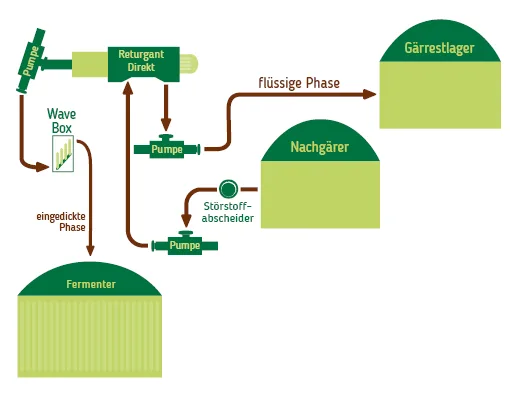
In a conventionally operated biogas plant, 75 per cent of the organic matter is broken down. As soon as a biomass recirculation filter is used in conjunction with ultrasound technology, the breakdown of organic matter increases to approximately 90 per cent. This enables an increase in biogas yield of up to 20 per cent from the original substrate fed into the biogas plant.

Design example
- Fermentation: approx. 40 m³/day
- Renewable raw material substrate mix with grass/GPS content
- Retention time: 60 days
- Volume load approx. 8 kg oTS/m³*d
- WaveBox 4 sonotrodes approx. 3.5 kW
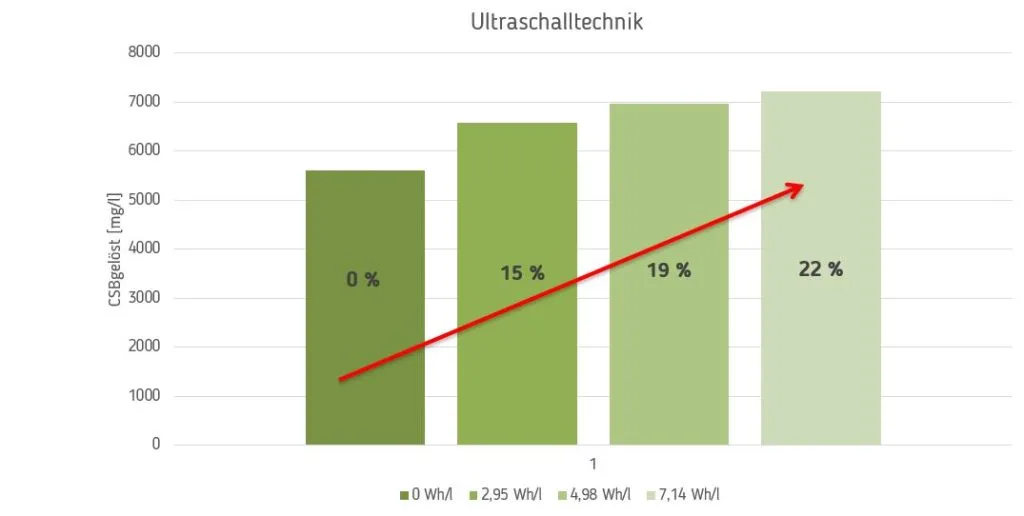
- Increase in biogas production by approx. 14 per cent
Technological aspects
Increased efficiency through an ultrasonic system
- Arrangement of the sonotrodes – maximum immersion depth
- Optimal gas removal
- No deposits
Effects on ultrasonic technology
- Significant reduction in the dry matter (DM) content throughout the system – thereby reducing operating costs
- Cost savings through increased organic degradation
- Improved agitability due to reduced shear forces
Environmental aspects
- Emissions are avoided
- Increase in the gas-forming potential of the feedstocks
- Reduction in the residual gas potential in the digestate
- Up to 20 per cent more biogas from the original material
Wavebox - Applications in biogas plants - Frequently Asked Questions (FAQ)
The WaveBox uses ultrasonic waves to break down fibrous substrates in a targeted manner. A pump conveys the substrate through the WaveBox, where sonotrodes generate ultrasonic waves. These sound waves form microscopic air bubbles which implode within the substrate. This cavitation effect breaks down the fibres in the substrate, enabling microorganisms to degrade the organic matter more quickly and efficiently.
The Wave-Box offers numerous benefits for biogas plants:
- It can be retrofitted into existing plants.
- The breakdown of organic dry matter can be increased by up to 20 per cent, which boosts biogas yield.
- Agitation times in the digestate storage tank are reduced, which can lower the energy requirements for the agitator.
- Foam formation can be prevented, which stabilises plant operation.
The WaveBox’s intelligent control system allows for flexible adaptation to the relevant operating conditions. The control unit can be used to adjust the flow rate, pressure and energy input individually to ensure optimum processing of the substrate. This ensures that the system runs efficiently and without disruption.
Wavebox - Applications in Sewage Treatment Works - Frequently Asked Questions (FAQ)
The WaveBox uses ultrasonic waves to break down sludge more efficiently. This improves the degradation of the organic components in the sewage sludge, which increases methane production in digesters and reduces disposal costs.
The breakdown of the cell structures in sewage sludge improves biological treatment. This results in better sludge stability and reduced odour formation.
The optimised cell disruption leads to faster and more complete fermentation of the organic material.
Yes, the WaveBox is designed for easy retrofitting and can be integrated into existing sewage treatment works without any problems. It is incorporated into the sludge circuit and can be flexibly adapted.
As the aerated sludge becomes easier to pump, the energy required for agitators and pumps can be reduced. At the same time, the volume of biogas produced increases, and with it the energy yield.
In a nutshell
The combination of the biomass recirculation filter, the retention of fibres that have not yet been fully fermented, and the treatment of the biomass using ultrasound is currently the only effective method for getting the most out of the substrate. This ensures that no gas potential is wasted, as high-energy feedstock is not left unused, regardless of retention times.
When feeding the plant, savings are made on the volume of feedstock, thereby reducing the strain (in terms of energy and wear and tear) on the feeding system.
The effective breakdown of the substrate’s fibres means that a gas yield increase of up to 20 per cent can be achieved.