Paddelrührwerke für Biogasanlagen
Effizienz, Homogenität und Zukunftssicherheit
Unsere Paddelrührwerke für Biogasanlagen
Vorteile eines Paddelrührwerks gegenüber alternativen Rührwerken
Paddle agitators for biogas plants
Paddle agitators are now regarded as the modern, energy-efficient solution for biogas plants – particularly when processing demanding or fibre-rich substrates such as maize silage, manure and grass silage. They set the standard for mixing quality, reduce operating costs and maximise biogas yield.
An overview of the advantages of paddle agitators
- Optimal, homogeneous mixing: No risk of floating or sinking layers; maximum biological stability.
- High gas yield: Efficient distribution of microbes and faster substrate conversion thanks to uniform agitation.
- Energy efficiency: Reduced electricity consumption thanks to highly optimised paddle geometry – often requiring only around two-thirds of the energy used by rod or submersible motor agitators.
- Low-maintenance and durable: Externally mounted, easily accessible drive unit and wear-free plain bearings – no need to enter the tank.
- Trouble-free operation even with difficult substrates: Substrates containing up to 15 % dry matter and fibre-rich contents can be processed without any problems.
- Flexibility in installation: Can be retrofitted; suitable for concrete or steel tanks.
- Safety: Optional ATEX version available for potentially explosive atmospheres.
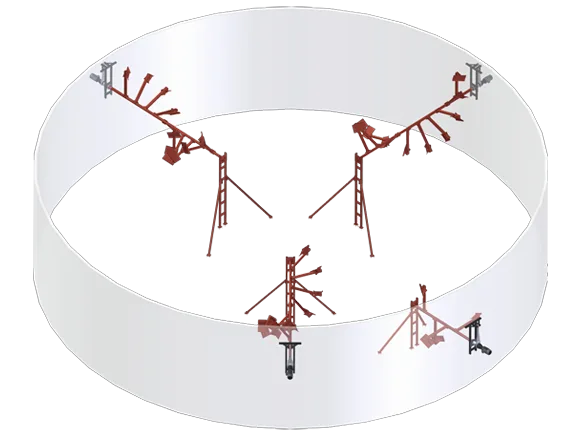
Comparison table: Paddle agitator vs. shaft-mounted, submersible motor agitator & central agitator
| Feature | Paddle agitator (e.g. Varibull) | Shaft-driven agitator | Submersible motor agitator | Central agitator |
|---|---|---|---|---|
| Mixing | Very homogeneous, prevents stratification | Homogeneity is often insufficient; stratification is possible | Often strong locally, but poor mixing over a large area | Prone to ‘dead zones’, particularly with large diameters |
| Suitability for fibrous substrates | Excellent, particularly for high dry matter content and high fibre content | Risk of rapid overload and winding issues | Rapid blockage with fibrous media | Sub-optimal flow with high viscosity and solids content |
| Energy efficiency | Low power consumption thanks to optimal paddle geometry | Higher energy consumption, particularly with viscous media | Very high power consumption during prolonged operation | Fluctuating, often high drive power |
| Maintenance & Service | Easy to access from the outside, low-maintenance, long service life | Complex maintenance, usually requiring access to the hopper | Regular maintenance inside the tank, close to the motor, wear parts | Sometimes complex: maintenance usually requires access inside the tank |
| Installation flexibility | Can be retrofitted, variable installation position | Dependent on tank shape | Good adjustment options, but limited mixing effect | Fixed central position, little scope for adjustment |
| Operational stability | High reliability even with dry matter (DM) content up to 15 % | Problematic with higher dry matter and solids content | Performance losses with viscous/challenging substrates | Sensitive to fluctuating fill levels |
| Service life | Very long, with wear-resistant bearings | Wear parts, frequent replacement | High wear, short service life due to aggressive media | Sometimes a long service life, but high maintenance requirements |
| Capital expenditure | Medium, very economical to run | Often cheaper, but high running costs | Initially inexpensive, but with additional costs due to maintenance | Often expensive in relation to benefits and maintenance |
Varibull Paddle Agitator – The Original for Your Biogas Plant
The Varibull paddle agitator offers innovation and safety from a single source:
- Four large, angled mixing paddles ensure rapid, uniform and energy-efficient mixing.
- Durable construction, maintenance-free seals and simple external maintenance ensure maximum operational reliability.
- Maximum gas yield through optimal mixing.
- Low power consumption and robust enough for any tank size.
- Suitable for all substrates, including fibre-rich media and high dry matter (DM) contents.
Paddle agitators in biogas plants - Benefits and applications - Frequently asked questions (FAQ)
A paddle agitator ensures uniform mixing of the process fluids and helps to homogenise the suspension in biogas plants. This optimises microbial activity and increases biogas production. The effective flow patterns and the appropriate paddle geometry make the fermentation process more efficient, resulting in a higher methane yield.
A paddle agitator is particularly well suited to energy-efficient mixing in biogas plants. Thanks to its robust agitator blades and the correct rotational speed, it requires less power to mix large quantities of substrate evenly. This reduces operating costs and improves the energy efficiency of the biogas plant.
Yes, paddle agitators are specially designed for processing fibre-rich substrates such as grass, maize silage or manure. They prevent blockages and ensure uniform mixing, which optimises gas and methane production. The paddle geometry is designed to function effectively even with high viscosities.
Thanks to its effective agitation technology, the paddle agitator ensures that substrates are mixed quickly and evenly. This reduces agitation times, which optimises energy consumption and makes gas production more efficient.
A paddle agitator can operate reliably even when fill levels in biogas plants fluctuate, as it distributes the substrate evenly. This ensures constant microbial activity and consistent gas production, even when the dry matter content is high.
Thanks to its robust drive system and maintenance-free plain bearings, the paddle agitator requires very little maintenance. It has a long service life and is characterised by low maintenance costs, which improves the economic efficiency of the biogas plant.
Yes, paddle agitators can be easily retrofitted into existing biogas plants. They are compatible with various types of digesters, whether they are made of steel or concrete. This enables a cost-effective and rapid retrofit.
The paddle agitator ensures uniform mixing and prevents foaming, which improves gas quality in the biogas plant. It maximises methane production and ensures higher gas output.
What are the main differences between a propeller agitator and a paddle agitator in biogas plants?
Pole agitators operate with a vertical mixing motion and are often suitable for deep digesters. However, they provide a lower mixing effect with fibrous substrates or high viscosities. Paddle agitators, with their horizontal mixing action, ensure uniform mixing of the substrates, even when fill levels fluctuate, making them ideal for biogas production.
Paddle agitators are more energy-efficient due to their agitation technique and the effective geometry of the paddles. They require less power and are ideally suited to biogas plants for reducing energy consumption. Rod agitators require more energy when dealing with high viscosities or difficult substrates and are therefore less energy-efficient.
Paddle agitators are significantly better suited to fibrous substrates such as maize silage or manure. They prevent blockages and ensure uniform mixing, whereas propeller agitators often encounter problems with high viscosities and fibrous materials.
Thanks to their robust drive technology and maintenance-free plain bearings, paddle agitators require less maintenance. They have a long service life and incur lower maintenance costs. Rod agitators, on the other hand, often require regular maintenance as they are more prone to mechanical faults.
Paddle agitators offer a high degree of flexibility and are suitable for various types of substrate. They operate effectively even at high liquid levels and can compensate for fluctuating substrate conditions. Shaft agitators are less flexible and are only suitable for specific applications, particularly with homogeneous liquids.
The paddle agitator ensures uniform mixing of the process fluids, which optimises microbial activity and thus methane production. Better homogenisation of the suspension leads to stable gas production, whilst propeller agitators are less efficient with heterogeneous substrates.
Paddle agitators require less maintenance due to their robust construction and low susceptibility to wear. Shaft agitators are often more expensive to maintain, as they require more spare parts and frequently cause problems with difficult substrates.
Paddle agitators are better suited to large fermenters, as they cope well with high substrate volumes and fluctuating liquid levels. This agitation technique ensures uniform distribution and higher gas production, which is often not the case with rod agitators.
Paddle agitators are more cost-effective in the long term, as they consume less energy and require less maintenance. Propeller agitators have higher operating and maintenance costs, particularly when used in challenging applications.
The Varibull agitator is based on the same tried-and-tested technology as the Paddelgigant, which we originally developed. Whilst other manufacturers have relocated their production abroad, we continue to manufacture the Varibull agitator in Germany. This enables us to ensure consistently high quality and durable workmanship. We have also refined the design in a number of areas to enable even more efficient mixing and a longer service life.