Optimised & User-friendly Solutions
Sepofarm Module: Screw press separator for farmers
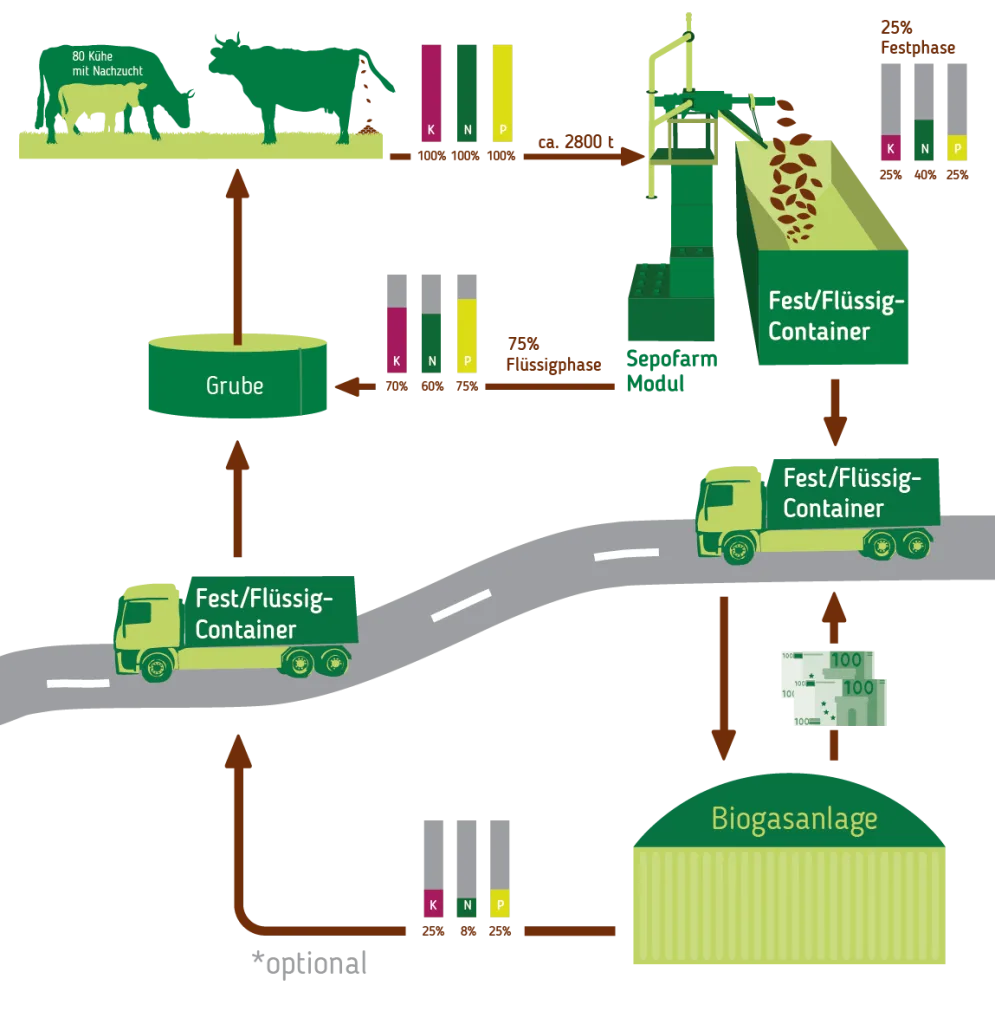
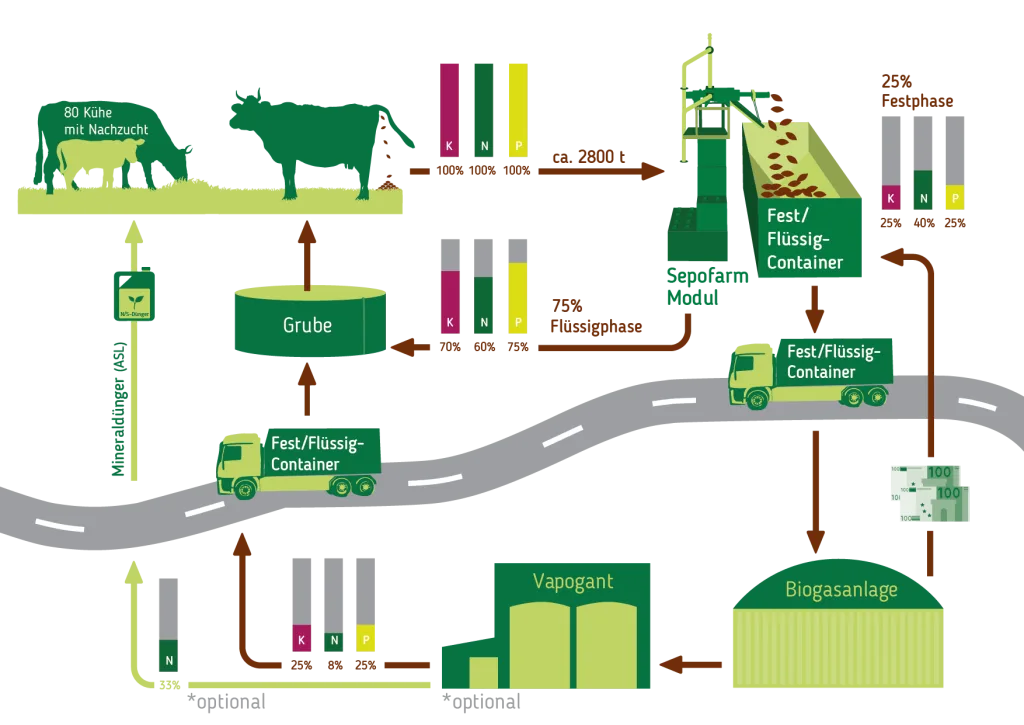
Sepofarm module: how the nutrient cycle works with the biogas plant
The solution for dairy farmers
The Sepofarm module combines the Sepofarm screw press separator with a specially designed dual-purpose container for transporting solids and liquids – ideal for farmers. Slurry is separated directly on the farm: the solids are transported to the biogas plant and digested, whilst the liquid fraction flows into the slurry tank. On the return journey, the fermented liquid fraction is brought back, eliminating empty runs, reducing storage requirements, and – optionally – producing ammonium sulphate (ASL) as a high-quality fertiliser via the Vapogant.
The problem & the solution
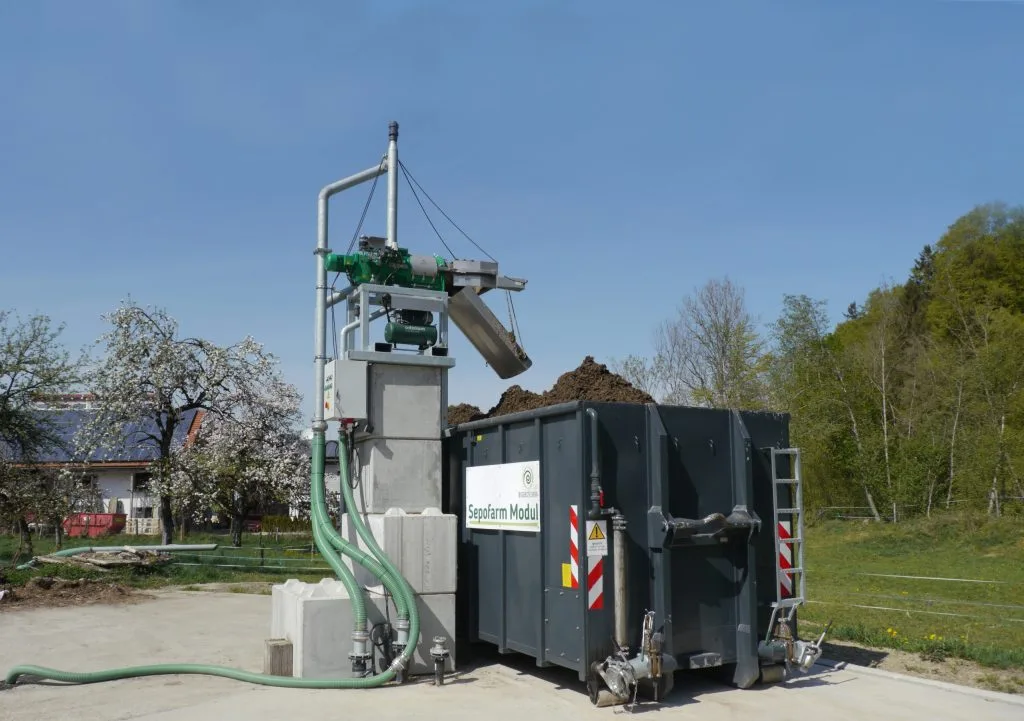
Not enough land and too much slurry! Many farms struggle with proper nutrient management. The nitrogen and phosphorus balance is often off, as neither can be applied to the fields in excessive quantities. Furthermore, nutrients are lost through ammonia emissions if application close to the ground is not possible. Thanks to the modular Sepofarm Modul separator, which consists of a separator and an easily transportable container (hook-lift), farmers can process the slurry promptly on their farm without long storage periods and utilise the fresh solids in a biogas plant. This had not previously been possible on this scale, as separators were usually permanently installed in one location and transporting the digestate proved difficult without a container designed for this purpose. This approach makes it possible to recover part of the phosphate via the solid phase produced during separation. In this way, efficient nutrient management can be achieved on agricultural holdings.
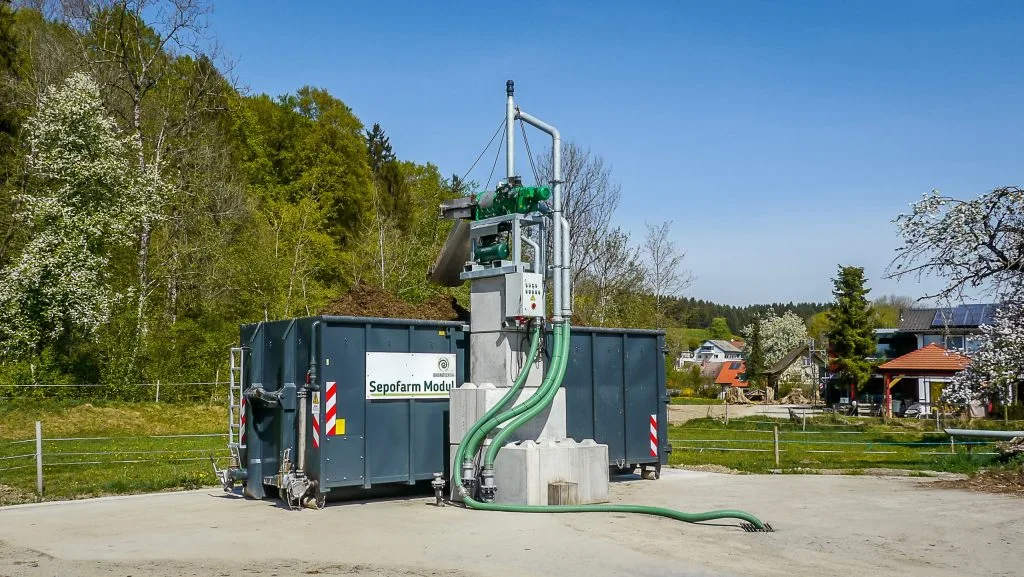
Slurry separation also makes it possible to produce bedding. This is an attractive alternative to conventional options, such as straw bedding, particularly for dairy farmers.
The procedure
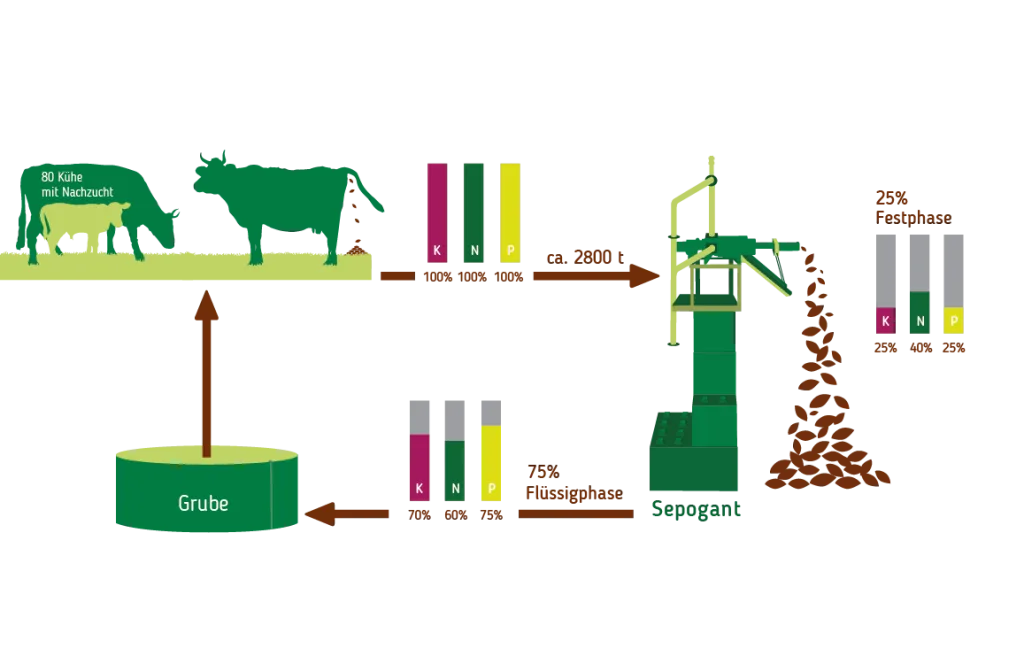
The slurry produced during livestock farming is first pumped into the Sepogant screw press separator. Here, the solids (approx. 25 per cent) are separated from the liquid fraction (approx. 75 per cent) in the slurry. The liquid phase is channelled into the pit, whilst the solids can be easily transported to another location using a solid/liquid container specially developed for this purpose. This makes it possible, for example, to transport the solid fraction to a biogas plant, whilst at the same time allowing for the return transport of either solid or liquid substrate.
Advantages of the Sepofarm module
for conventional and organic farms
- Essentially, all the benefits of Sepogant
- cost savings on straw when solid material is used as cubicle bedding
- Cost savings on the slurry tank agitator
- Cost savings on the construction of slurry storage tanks
- Cost savings when using a drag hose instead of a drag shoe distributor
- Reduced N losses due to application close to the ground and rapid penetration into the soil
- Savings on water used for dilution
Partnership with Sepofarm Modul

Biogas plant operators
- Separated manure from slurry as a substitute for maize
- Land-saving
- wider choice of potential partners
- Optimal nutrient management

Dairy farmers
- Increased efficiency through separation
- Inventory reduction of up to 25 per cent
- Substrate supplier for biogas plants
- Space savings
- Optimised application
- Solution to nutrient management issues
- CO₂ -neutral production
- Emissions reduction
Sepofarm Module and Vapogant
- In-house mineral fertiliser production (ASL)
- significantly more efficient use of nitrogen
- Optimal nutrient management
- Reduction in transport and storage volumes through the processing of fermentation products
- Lower investment in digestate storage
In a nutshell
By separating the components, agricultural businesses can increase their profitability, reduce their stock levels and thus save space. Furthermore, the liquid fraction of the digestate can be optimised and applied close to the soil surface. The removal of the solid fraction, which contains approximately 20 – 30 per cent of the phosphorus, also resolves the nutrient issue. In return, biogas plant operators can use the pressed solid material (manure) to replace maize and renewable raw materials in the biogas plant. This means they do not need to grow these crops themselves, thereby saving on land and reducing emissions. Furthermore, this model offers them a wide range of potential cooperation partners. Ultimately, both farms and biogas plant operators can benefit from using the Sepofarm module and the circular economy it enables – creating a win-win situation.
The nutrient cycle of the future
factfeeder
The Sepofarm Module is a cutting-edge technology. It is simple and flexible to install. Our sales team can easily work out for you whether the Sepofarm Module is cost-effective for you!