SEPOGANT
Separation technology for biogas plants
Our separation technology offers innovative, high-performance solutions for the reliable separation of solid, viscous and liquid substances – in livestock farming, on farms, in biogas plants, and in biotechnological and industrial applications. Whether it’s slurry, digestate or organic waste: our modular and robust technology optimises nutrient recovery, reduces storage costs and improves economic efficiency through resource-conserving processes.
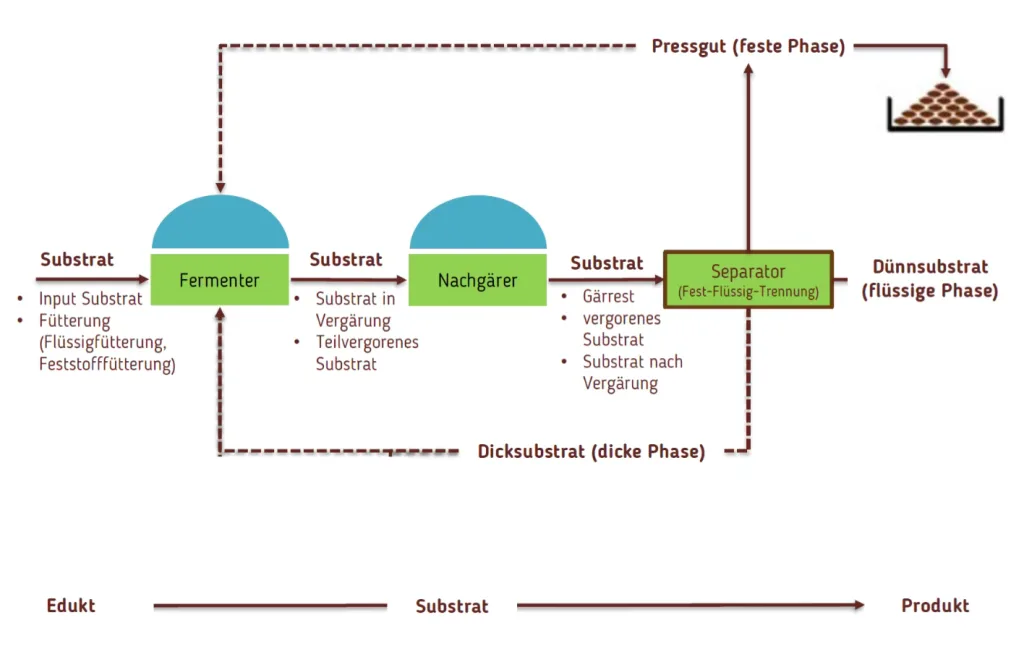
The units are available in various configurations: as stationary plants with direct recirculation of solids back into the digester, as mobile systems on transport frames, or as container-based modules. This allows them to be flexibly adapted to the structural and operational requirements of biogas plants or, for example, dairy and beef cattle farms, as well as pig farms.
The separators optimise nutrient recycling, reduce the storage volume of liquids and solids, and lay the foundation for the targeted, close-to-the-ground application of the separated slurry. This supports efficient nutrient utilisation, improves process stability and increases the economic efficiency of the entire operation.
The problem & the solution
Settling and floating layers can form in digestate storage tanks at biogas plants. These can often only be prevented or broken up using costly agitation technology. Upstream separation significantly reduces this problem and thereby lowers the energy and technical costs associated with the digestate storage tank. Separation also supports needs-based nutrient management on farms. In industrial waste treatment plants, it can also be used to separate plastics and other contaminants.
The separation technology divides digestion substrates into a solid, viscous and liquid phase. This allows the nutrients to be distributed in a targeted manner: the immediately available ammonium nitrogen (NH₄) is predominantly found in the liquid phase, whilst organically bound nitrogen and phosphorus are largely separated out with the solid phase. In this way, both fractions can be utilised efficiently and in line with requirements.
The liquid phase is particularly suitable for application close to the soil on arable and grassland areas. The solid phase can be applied to arable land or, after each grassland cut, using a disc manure spreader. On dairy and beef cattle farms, it can also be used as bedding or as a partial replacement for straw bedding. This reduces the need for purchased straw – potentially eliminating the need for it entirely, depending on the housing system.
Separating the solid phase also reduces the storage volume required for fermentation substrate in biogas plants. Storage volume can also be reduced on livestock farms. At the same time, the formation of settled and floating layers in the storage tanks is minimised, meaning that less mixing equipment and energy are required.
Pressschneckenseparator
Sepogant Direct
Biomasserückführfilter
Returgant Directly into the container
Download brochures
Das Vefahren
The screw press separator separates both slurry and more challenging feedstocks, such as digestate or substrate from waste treatment plants. This is made possible by the robust screw press, which is fitted with carbide inserts, and the carbide counter-blade. The mechanical seal (with permanent oil lubrication), which we have specially developed, ensures long maintenance intervals and a high level of safety. The linearly constant contact pressure allows for seamless adaptation to different substrates.
During separation using the Sepogant screw press separator, the medium – slurry, digestate or other residues – is separated into a solid and a liquid phase. Here, the press screw drives the substrate through the rigidly mounted, stationary slotted filter screen and presses it against the press cone or press flap. As a result, the liquid portion of the substrate drains off through the slotted filter screen. The solid part of the digestate is conveyed forwards out of the Sepogant against the pressing mechanism.